nīrājana
A Journal of Arts & Ideas
Morikā
Four surviving shlokas are all that remain of this thirteenth-century poetess, each a small, perfect study of devotion and longing, proof that a poet’s stature was never measured by volume.

Written by
The tree of language finds its life only through people with beautiful minds. The radiance of their feelings is its sunlight. Their aesthetic experiences (rasa-anubhuti) are its water. Their breaths are its pure air. The very lumps of words that emerge from them are its soil. Even hundreds of years later, if a person unwittingly approaches a tree nurtured in this way, his heart will undoubtedly find solace in its cool shade.
All Indian languages, having yielded to such poets, continue to exude grace with eternal youth even after hundreds of years. These gardeners cultivated these poetic orchards with great heart, leaving their flowers and fruits for future generations, but never once wrote their names in front of them saying, “This is the garden I planted.”
Morika is one such poetess who planted trees of poetry that continue to bloom in the Sanskrit language today.
Apart from her name, no other details are known about this aesthetically sensitive soul (rasahrudaya), under whose name only four shlokas (verses) are currently found. Jalhana was the first to collect these, doing the world a sweet favor and leaving us indebted to him. Based on this, it is surmised that she must have lived in the 13th century or earlier.
Her mind is a pure temple of love. Her poetry is sweeter than the sweetest.
Consider this shloka:
प्रियतमस्त्वमिमामनघार्हसि
प्रियतमा च भवन्तमिहार्हति ।
न हि विभाति निशारहित:
शशी न च विभाति निशापि विनेन्दुना ॥
“O faultless one (anagha)! You, who are her beloved, are the only one worthy of this young woman. And she, who is the queen of your heart, is the only woman worthy of you. A moon without the night does not shine, nor can the night radiate light without the moon.”
In this shloka, she defines the true qualification for love between a young man and woman. That qualification is simply being beloved to each other. The poetess addresses the young man not as “O wealthy one,” “O powerful one,” or “O valorous one,” but as “O faultless one” (anagha), which reflects her own elevated nature. How many possess such refined culture (samskara)? This shloka stands as an example that women of that era desired a pure heart. Instances where women uplifted men not just as mothers, but as wives and lovers, are numerous, ranging from the times of Kalidasa to Tulsidas.
मा गच्छ प्रमदाप्रिय प्रियशतैरभ्यर्थितस्त्वं मया
बाला प्राङ्गणमागतेन भवता प्राप्नोत्यवस्थां पराम् ।
कि चास्याः कुचभार-निःसहतरैरङ्गैरनङ्गाकुलैस्
तृट्यत्कञ्चुकजालकैरनुदिनं निःसूत्रमस्मद्-गृहम् ॥
These are the words spoken by the heroine’s friend to a man who is setting out on a journey to a distant land, leaving the heroine behind:
“Do not go, O lover of women! I have already pleaded with you in a hundred affectionate ways. Just by you stepping into the courtyard of this house, our girl is driven into an indescribable state of longing (viraha). Every day,as her limbs agitated by passion and unable to bear the weight of her breasts, cause her bodice bursts at the seams; in fixing them daily, our house has entirely run out of thread from fixing them!”
pramadāpriya = O lover of women. This is a highly contextual address. By awakening the lover in him, she makes her plea touch his heart.
nissūtraṃ = devoid of thread / devoid of happiness (which is the unifying thread of a home). This is a pun (shlesha).
bālā = young girl. By describing the lover as a young girl, it suggests (dhvani) that the punishment he is inflicting upon her is unjust. It also underscores her helplessness.
This is composed in the Śārdūlavikrīḍita meter. The way she has orchestrated it is extraordinary.
Hearing her words, the man—who intrinsically does not wish to leave his beloved but is unable to cancel his journey—laments in turmoil like this:
यामीत्यध्यवसाय एव हृदये बध्नातु नामास्पदं
वक्तुं प्राणसमा-समक्षमघृणेनेत्थं कथं पार्यते।
उक्तं नाम तथापि, निर्भरगलद्-बाष्पं प्रियाया मुखं
दृष्टवाऽपि प्रवसन्त्यहो धनलव-प्राप्तिस्पृहा मादृशाम् ।।
“If only the very thought of me leaving would just bury itself permanently in my heart, how wonderful it would be! How can a cruel man like me cross the wretched state of standing before my beloved, looking into her face, and breaking this news? Even after saying it, looking at my beloved’s face drenched in cascading tears, it is the bitter fate of men to still leave her! People like me have no other consciousness except the desire to hoard a little wealth!”
yāmi + iti + adhyavasāyamu = the resolve saying, “I am going.”
hṛdayē badhnātu = may it remain bound within the heart itself. What a profound usage this is!
prāṇa-samā = equal to life. This indicates his deep love.
aghṛṇēna = by me, who is cruel. This indicates his utter helplessness.
nirbhara-galat-bāṣpaṃ = tears streaming relentlessly—a beautiful compound (samasa).
pravasanti = in the sense of ‘men travel to foreign lands’. It implies that every man burdened with the responsibility of earning wealth must endure this agony.
I have merely pointed out a few phrases that struck me, but every single syllable in this shloka is completely drenched in the nectar of emotion (bhava-amruta). This is a composition that only a highly practiced poetess and scholar could create.
When reading this poetry, and reflecting on how deep the conversations between lovers used to be in those times, and how powerfully they experienced the emotions of love and separation, one feels how much the minds of today’s youth—who are constantly obsessing over “communication” in relationships—have to learn. Not just yoga (spiritual discipline), but experiencing bhoga (worldly pleasure) completely also requires immense dedication and practice. This is the message Morika’s poetry imparts to us.
The next shloka elevates her to the status of a master poetess (kaveeshwari). Look at this:
लिखति न गणयति रेखाः
निर्भर-बाष्पाम्बु-धौत-गण्डतला।
अवधि दिवसावसानं
मा भूदिति शङ्किता बाला ॥
likhati na gaṇayati rekhāḥ nirbhara-bāṣpāmbu-dhauta-gaṇḍatalā। avadhi divasāvasānaṃ mā bhūditi śaṅkitā bālā
Although this priceless gatha (I do not feel like calling it a shloka; this incident must have either happened in the poetess’s own life, or she must have witnessed it firsthand) seems to have its roots in the “ajjaṃ gaōtti” gāthā from the Gāthāsaptaśatī, the shade of its beauty is entirely novel.
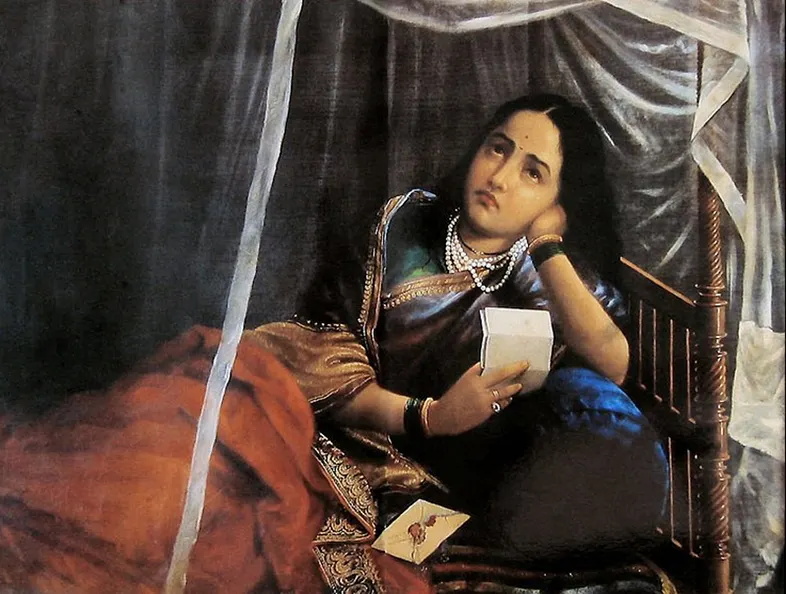
In those days, women would draw lines on the walls either pointing to the day their lover was scheduled to return, or counting the days since he left. This young girl, in the agony of separation from her lover, is drawing lines to count the days since he departed, as tears stream down from her eyes. She is drawing the lines, indeed, but she cannot bring herself to count how many she has drawn—out of the fearful suspicion that the deadline her lover gave, saying “I will return on this day,” might have already expired.
likhati na gaṇayati = she is drawing, but not counting. Both are happening simultaneously. If she isn’t going to count, why draw? Having drawn, why not count?
bāṣpāmbu-dhauta-gaṇḍa-talā = she whose cheeks are washed by the waters of her tears. A beautiful compound.
bālā = young girl. It implies (dhvani) that in her grief, she has forgotten her age. It also means one with a tender heart.
Hers is a state where, drenched in her lover’s love, she is unable to count the lines. Mine is a state where, drenched in this poetic nectar, I am unable to offer any commentary beyond this.
The Indian woman is the ultimate guru of pure love.
Should we merely call this composition, written in the Arya meter, a “small shloka”? As a tribute to the sweetness dripping from every single syllable in it, shouldn’t this poetess be carried in a palanquin just as many times?
(This essay is translated from the Telugu original series by the author, Kavayitrī Samayālu.)

Be the first to share your thoughts.