nīrājana
A Journal of Arts & Ideas
Mārulā
Only two verses survive under her name, yet they are enough to place this poetess among Sanskrit literature’s finest voices on the ache of separation: a life almost entirely unknown, preserved in two shlokas of startling emotional precision.

Written by
The qualities and characteristics required for good poetry are many. Depending on the poet’s capability, an ordinary, mediocre, or great poet is born. While these differences exist in the poetry that is expressed and brought outward, are there differences in the minds that give birth to them? It is my belief that a mind capable of birthing great poetry must possess certain characteristics. There is no other way but for that mind to be crystal clear. There is no other method but for it to be devoid of deceit. There is no other path but to be able to conceptualize with a vision of single-minded, meditative focus.
True poetry is that which is born from the pure mind of the poet, brought forth through their genius and erudition (pratibha-vyutpatti), and which manages to evoke an unprecedented joy in any seeker of poetry who encounters it. That is why classifications like ‘old’ and ’new’ do not always apply to poetry. It is ageless and immortal.
There is no divine mandate decreed by Brahma stating that a person must compose a specific number of poems to be considered a ‘poet’. Length is never a boundary for the term kavya. Even if one composes just a single shloka, if it can stir a surge of joy in the minds of those who read it and turn that joy into a lasting memory for them, it becomes a great shloka. That poet becomes a revered figure. One such royal swan of a poetess lived in India. Her name is Marula.
It is surmised that she belonged to the Kannada region, and since one of her shlokas is found in Jalhana’s anthology, the Suktimuktavali, she must have lived sometime during or before the 13th century. It appears she was also referred to by various names such as Marumala, Manala, and Sarula. Aside from this, absolutely nothing is known about her origins, her education, the paths she walked, or the joys and sorrows she experienced. There is no information on whether she composed full-length epics (kavyas), whether she waited for patronage in royal courts, or whether she received any honors or felicitations. We do not even know if she was blessed by the grace of fame while she was alive. Only one thing is known—her work. And that is the act of laying her pure heart bare before us through her poetry. For me, that alone is reason enough to write about a human being who has absolutely no connection to our own lives.
There are only two shlokas available under her name.
As mentioned above, the first shloka is from the Suktimuktavali, while the second is from the Sharngadhara Paddhati. Reading these two shlokas and glimpsing her essence within them, one immediately feels that even authors of hundreds of volumes might pale in comparison to such an embodiment of poetry. One cannot help but reflect on the immense good fortune (sukruta) of the people who surrounded her—having a girl with such a mind as a friend, daughter, sister, lover, or wife. Her thoughts are as warm, rich, and pure as freshly drawn milk. Her poetry drips nectar from every angle. The mature essence of separation (paripakva-viraha) born in her poetry is not something we can find so easily elsewhere. If there is any supreme glory to the aesthetics of separation (vipralambha-mahima), this is it.
Be it this poetess’s flow, her emotional depth, or her use of tiny, delicate words and compounds (alati alati pada-samasalu) that chase profound meanings—reading them just once makes you want to recall them again and again.
Above all, it makes one feel that if they were to love anyone, they should love like her. Not just her, but every poetess I am going to introduce to you is a guru of love. She is an embodiment of affection (anuragamayi). She is the purest manifestation of nature. She is the ultimate, majestic proof (sakshyarajam) of what a rare creation the Indian woman is.
Look at this:
गोपयन्ती विरहजनितं दुःखमग्रे गुरूणां
किं त्वं मुग्धे नयनविसृतं बाष्पपूरं रुणत्सि।
नक्तं नक्तं नयनसलिलैरेष आर्द्रीकृतस्ते
शय्योपान्तः कथयति दशामातपे शोष्यमाणः॥
gopayantī virahajanitaṃ duḥkhamagre gurūṇāṃ kiṃ tvaṃ mugdhe nayanavisṛtaṃ bāṣpapūraṃ ruṇatsi। naktaṃ naktaṃ nayanasalilaireṣa ārdrīkṛtaste śayyopāntaḥ kathayati daśāmātape śoṣyamāṇaḥ
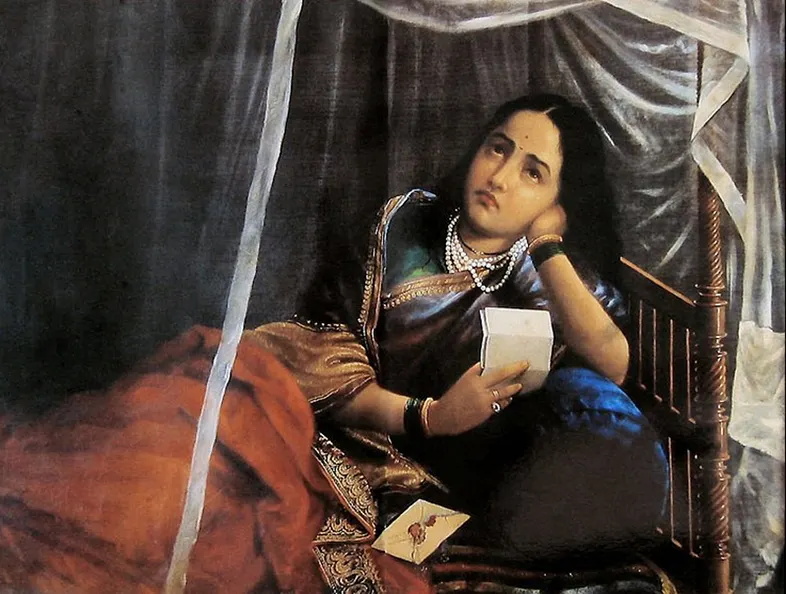
This is an emotion-centric shloka. A girl is dragging her life through the agony of separation from her lover. For her, a moment is an aeon. Sorrow is her closest confidante. A smile is a complete stranger. The elders at home are not the sort who would understand her. She has nowhere to turn to share her pain. Hers is a state where she must conceal her innermost feelings in their presence. One day, she is laying her pillow out to dry in the sun. A friend who arrives there observes all this and says to her:
“O Mugdha (innocent one)! Are you swallowing the tears born of your burning separation, forcing them back down your throat because you cannot show them in front of the elders? You soak this pillow into a soggy mass with your tears every single night, and lay it out to dry in the sun every single day—this pillow of yours is declaring your plight without uttering a single word!”
What a beautiful description this is! I feel tempted to say that, just like for Kalidasa, the Mandakranta meter has surrendered at her feet (padakranta).
naktaṃ naktaṃ = every night. A beautiful usage, implying that she cries every single day.
nayana-salilaiḥ = by the waters of her eyes (tears).
ātapaṃ = in the sunlight.
ārdrīkṛta = made wet / soaked.
mugdhē = O innocent/beautiful woman!
I have made an attempt to present the meaning of this shloka before you in the words that occurred to me, but I truly do not know how to adequately express the magic and sweetness woven into the original poem. Now that you know the underlying emotion, my only humble request is that you sit in peaceful solitude and read the shloka to yourself one more time.
After some time had passed, her lover returned from a foreign land. He went to see her. She had changed beyond recognition. The two of them spoke. Later, the lover shared that conversation with his friend in this manner:
कृशा केनासि त्वं? “प्रकृतिरियमङ्गस्य ननु मे”
मला धूम्रा कस्मात्? “गुरुजनगृहे पाचकतया ।
स्मरस्यस्मान् किञ्चिद्? “नहि नहि नही"त्येवमगमत्
स्मरोत्कम्पं बाला मम हृदि निपत्य प्ररुदिता ॥
kṛśā kenāsi tvaṃ? “prakṛtiriyamaṅgasya nanu me” malā dhūmrā kasmāt? “gurujanagṛhe pācakatayā । smarasyasmān kiñcid? “nahi nahi nahī"tyevamagamat smarotkampaṃ bālā mama hṛdi nipatya praruditā ॥
“Why have you grown so thin?”
“I haven’t. My body has always naturally been this way, hasn’t it?”
“Why are you so covered in dust and soot? You aren’t wearing a single ornament!”
“It’s nothing. I don’t sit idle, you see. I cook for the elders in the house. That’s why.”
“Alright. Did you ever think of me?”
“No… no… no…”
Saying thus, unable to hold it in any longer, she collapsed onto his chest and wept bitterly.
The heroine might indeed have been doing the household chores. However, the truth is she is emaciated by the agony of separation (virahakrushita). She hesitates to admit this before her lover. She is desperate to let him know that she was perfectly fine even in his absence. She suspects that if she admits she cannot survive without him, he might take her for granted. Therefore, she provided alternate excuses for every question. Yet, with every question her lover asked, the wall of fortitude built around her heart began to crack. By the time he asked, “Did you ever remember me?”, it completely collapsed. Even then, trying not to give in, she answered, “No.” Here lies the genius of the poetess—making her utter the word “No” three consecutive times. It signifies that she is trying to hold back her emotions with every ounce of her strength. By the time she said “No” for the third time, unable to hold back the surging sorrow, she wept aloud, bringing the intense conflict in her mind to a close.
Composed in the Shikharini meter, the portrayal here truly reaches the very peaks (shikharayamanam) of poetry.
mama hṛdi nipatya = collapsing onto my chest/heart.
smarōtkampaṃ = the trembling born of passion / the agony of love.
praruditā = weeping bitterly.
Due to the usage of the phrase “mama hṛdi nipatya” (collapsing on my chest), we must understand that the lover is recounting this incident to his friend or an acquaintance. How many possess the capability to compose poetry this beautiful? That is exactly why the majestic history of Sanskrit literature was so charmed by her that it reserved a page entirely for this poetess. All the poets of her era bowed in reverence to her poetry. The great poet Dhanadadeva, who gathered and praised all the great poetesses of Sanskrit literature in one place, gave her a spot on that list, seating her in the highest ranks. That is our greatest fortune.
**
(This essay is translated from the Telugu original series by the author, Kavayitrī Samayālu.)

Be the first to share your thoughts.