
nīrājana
A Journal of Arts & Ideas
The Most Erudite Verse in Telugu Literature
A journey through Telugu and Sanskrit poetry’s most dazzling feats of verbal engineering, featuring verses built from a single repeated syllable, bilingual shlokas, and riddles hidden in plain sight, and culminating in a newly reconstructed verse the author calls the most erudite poem in the language.

Written by

Translated by
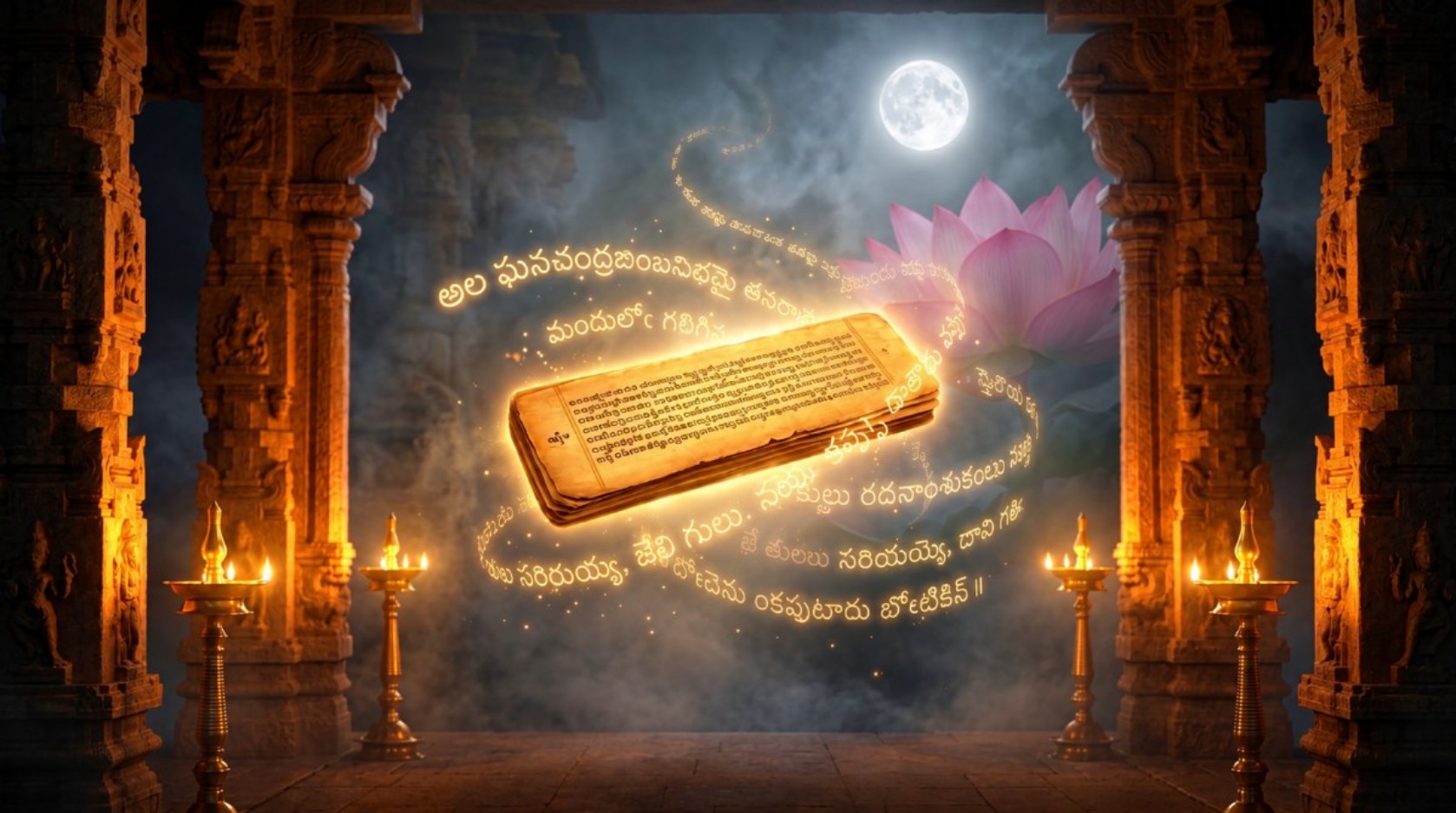
Which is the most erudite (praudha) verse in all of Telugu literature, a tradition that has flourished for over a thousand years? Answering this question is no easy task. Across thousands of kavyas, there are many verses whose exact meaning is difficult to ascertain due to obscure vocabulary (apratita-pada-prayoga), convoluted syntax (anvaya-klesha), or dense conceptual depth (bhava-praudhi).
While the habit has faded today, there was a time when literary gatherings (vidya-goshthis) thrived on testing scholars with such linguistic puzzles. Presenting a complex verse and asking for its meaning was a favourite intellectual pastime for both examiners and examinees. A famous anecdote recalls that when the scholar-poet allamarāju subrahmaṇyakavi visited the princely estate of māḍugula, he was challenged to explain this tongue-twisting verbal artifice (shabdachitra) composed by tnāli rāmakṛṣṇa from his lost work, the kandarpaketuvilāsamu:
కమలాకరకమలాకర
కమలాకర కమల కమల కమలాకరమై
కమలాకర కమలాకర
కమలాకరమైన కొలను గని రా సుదతుల్.
kamalākarakamalākara
kamalākara kamala kamala kamalākaramai
kamalākara kamalākara
kamalākaramaina kolanu gani rā sudatul.
As the traditional interpretation propounded by Subrahmanya Kavi is no longer extant, I have construed the verse as best I could, offering what Telugu tradition delightfully calls a “maternal uncle’s likeness” (mēnamāma pōlika)—a close, family resemblance rather than an exact replica:
- ā sudatul = Those beautiful women with lovely rows of teeth;
- kamalā = of Goddess Lakshmi’s;
- karakamala = lotus-like hands;
- ākara = as the held object (abode);
- kamala = to the lotus flower;
- ākara = being the birthplace;
- kamala kamala kamalākaramai –
- kamala = for the cranes (water birds);
- kamala = for the pure waters;
- kamalā = for Goddess Lakshmi herself;
- ākaramai = being a serene dwelling place;
- kamalākara –
- ka = of Cupid (Manmatha);
- ma = enchanting;
- lā = captivating power;
- kara = evoking / bringing about;
- kamalākara –
- kamalā = for the Padmini class of women;
- ka = within their bodies;
- ra = kindling the fire of passion;
- kamalākaramu + aina = being such a prosperous and all-bestowing;
- kolanun = magnificent lake;
- kaniri = they beheld (as a feast to their eyes).
Overall Meaning
Those beautiful women beheld a magnificent lake that was a feast to their eyes. It was the birthplace of the lotus flower, which the lotus-like hands of Goddess Lakshmi hold. It was a serene dwelling place for cranes, pure waters, and Goddess Lakshmi herself. It evokes the enchanting and captivating power of Cupid and kindles the fire of passion within the bodies of Padmini women. Upon such a prosperous, all-bestowing, and beautiful lake, they gazed.
A well-known scene from the classic film tnāli rāmakṛṣṇa illustrates this very tradition of scholarly testing: a visiting pandit from the koṇḍavīḍu province arrives at the court of śrīkṛṣṇadevarāya and challenges the assembly to interpret the dense verse “Rājanandanarājarājātmajulu sāṭi, talaṁpa Nannaya Vēma dharaṇipatiki”, only to be humiliated and outwitted by Ramakrishna. In traditional schools of the past, teachers rigorously trained students to memorise lexicons specifically to untangle verses composed around single consonants or monumental compounds.
Single-Letter Virtuosity
A striking example of extreme formal constraint is found in the twelfth-century Sanskrit masterpiece Yamakaratnākaram by śrīvatsāṅka(Koorathazhwan), a revered disciple of Bhagavad rāmānuja. Composed in the achaladhriti metre (consisting entirely of sixty-four short syllables, sixteen per quarter), this hymn from the twelfth canto uses only the single consonant ‘da’ (ekākṣaraśloka) to voice the inner thoughts of Krishna’s childhood friend Sudama, who pours out his heart in praise to the Lord for welcoming him with deep affection and blessing him with boundless fortune:
దదదదదదదదదదదదదద దద-
దదదద దదద దదదదదదదదద
దదద దదదద దదద దదద దదద
దదదద దదదద దదదద దదదద.
dadadadadadadadadadadadada dada-
dadada dadada dadadadadadadada
dadada dadadada dadada dadada dadada
dadadada dadadada dadadada dadadada.
(To the surrendered, You are an obedient refuge; to the indifferent, You remain aloof; to the sinful, You are the destroyer; You vanquish the demons, exalt the virtuous, sustain the righteous, grant liberation to the noble, chastise the tormentors of the good, shield the protectors of saints, and dwell as Lord Vasudeva within and beyond the cosmos! Refuge, refuge in You!)
Through careful word-splitting (pada-chheda), this seemingly unbroken string of a single syllable yields a nuanced philosophical prayer:
-
dadadadadadadadadadadada = dadat + adadat + ada + dadat + adadat + ada. dadat = among donors; adadat = among the uncharitable; ada = among devourers; dadat = among self-surrendering devotees; adadat = among those indifferent to worldly bonds; ada = You who bestow spiritual wisdom (or adadat = among sinful exploiters; ada = You who inflict torment, O Sovereign of the Worlds!).
-
dadadadada = dadat + adat + ada. dadat = the righteous; adat = tormenting villains; ada = You who slay them, O Protector of Creation!
-
dadada = dada = noble souls of sacrificial nature; da = You who exalt them!
-
dadadadadadada = dadat + adadat + adat + ada. dadat = among the pious; adadat = among those dispassionate towards action and inaction; adat = among those bound by karma; ada = You who remain equanimous and dissolve all at the cosmic dissolution!
-
dadada = dada = the righteous; da = You who hold them in Your heart!
-
dadadada = dadadat = the demons who afflict saintly sages; ada = You who annihilate them, O Lord Vasudeva!
-
dadada = dadat = to sacrificial performers who offer oblations to the gods; ada = You who protect them, O Supreme Lord!
-
dadada = dadat = Your noble devotees; ada = You who test and purify them!
-
dadada = dadat = those who show compassion for the world’s welfare; ada = You who preserve them, O Merciful One!
-
dadadada = dada = those devoted to righteousness; da = the wicked who harass them; da = You who strike them down!
-
dadadada = dadat = to the upholders of dharma; ada = to those who fail to uphold it; da = You who apportion the fruits of their karma!
-
dadadada = dadat = to the scourges of the world; da = the vile men who shield them; da = You who destroy them, O paramātman!
-
dadadada = dadat = O Giver of all; adadat = You who bring an end to karmic bonds and grant purity of heart; a = O Lord Vasudeva!
Syncretic Erudition
Another type of erudition blurs the lines between languages. Take tenāli rāmakṛṣṇa’s daśāvatāra stuti. Hearing it recited, one might wonder whether it is Telugu or Sanskrit:
ద్యూత్తంభద్గిరి-కల్పితావతరణ-ద్యోవాహినీ-సంగమో-
పాత్తేందూదయ-నిష్పితౄణ-జలధి-ప్రారబ్ధ-పుత్త్రోత్సవో-
దాత్తత్వాత్త-గజాశ్వ-వన్యశన-కన్యా-గో-మణీ-దాన-సం
పత్తి-ప్రీణితదేవ ఢుల్యధిపతిబ్రహ్మన్! స్తుమ స్త్వా మనున్.
dyūttambhad-giri-kalpitāvataraṇa-dyovāhinī-saṅgamo-
pāttēndūdaya-niṣpitṝṇa-jaladhi-prārabdha-puttrotsavo-
dāttatvātta-gajāśva-vanyaśana-kanyā-go-maṇī-dāna-saṃ
patti-prīṇitadeva ḍhulyadhipatibrahman! stuma stvā manun.
The poetic imagination here is as magnificent as the verse is structurally formidable. The entire stanza consists of an unbroken, majestic Sanskrit compound in praise of Vishnu’s Kurma (tortoise) incarnation.
dyu = in the sky; uttambhat = soaring during the churning; giri = by the Mandara mountain; kalpita = facilitated; avataraṇa = descent; dyōvāhinī = of the celestial river Ganges; saṅgama = through the union; upātta = obtained; indu = of the son named the Moon; udaya = due to the birth; niṣpitṝṇa = freed from ancestral debt; jaladhi = by the father, the Ocean of Milk; prārabdha = initiated; puttrōtsava = of the festival celebrating the birth of the son; udāttatva = to the grandeur; ātta = befitting;
gajāśva-vanyaśana-kanyā-gō-maṇī-dāna — gaja = the elephant Airavata, aśva = the divine horse Uchchaihshravas, vanī = the grove of wish-fulfilling Kalpa trees, aśana = the nectar of immortality (Amrita), kanyā = Goddess Lakshmi along with her maidens, gō = the wish-fulfilling cow Kamadhenu, maṇī = the Chintamani jewel, dāna = of the gifts;
sampatti = by the abundance; prīṇita = pleased; deva = the gods like Indra;
ḍhulyadhipatibrahman — ḍhulī = to the female tortoise (Goddess Kamathi), adhipati = who is the husband, brahman = O Lord!; tvāṃ = You; stumaḥ = we praise.
“O Lord! When gods and demons churned the cosmic ocean using Mount Mandara as their churning rod, you assumed the form of a cosmic tortoise (ḍhulyadhipati) to support the mountain on your back. As Mandara spun rapidly under their violent churning and scraped the skies, the celestial river Ganga descended along its slopes into the ocean. Through that sacred union with Ganga, the Ocean fathered the Moon as his son. Overjoyed that the birth of a son had freed him from the punnāmanaraka and absolved his ancestral debt (pitri-rina), the Ocean celebrated the birth-festival by gifting the seven miraculous treasures—the elephant Airavata, the steed Uchchaishravas, the celestial Kalpavriksha tree, the divine nectar, the maiden Lakshmi, the wish-yielding Kamadhenu, and the Chintamani gem—satisfying the gods. O that Supreme Lord, we praise You!”
The grammatical marvel of the stanza lies at its very end: Ramakrishna appends a single Telugu quotative marker (anun, fusing with the Sanskrit stumaḥ tvām into stumastvāmanun—“saying, ‘We praise you’”). With that single native particle, the entire colossal Sanskrit edifice transforms instantly into a valid Telugu verse.
Pure Telugu Compounds
Such erudition is not confined to heavily Sanskritised compounds charged with martial vigour (ārbhaṭī-vṛtti and ojo-guṇa). Monumental compounds crafted entirely from pure native Telugu (Accha Telugu) are equally possible, though they typically exemplify syntactic magnitude rather than dense internal obscurity.
Consider this verse from Gaṇapavarapu Veṅkaṭakavi’s prabandharāja veṅkaṭeśvara vijayavilāsamu (1-126):
నెలఱాతీనియ సంతనంపు మగఱా నీరాళపుం గొప్పటా
కుల నిద్దంపుఁ బసిండి నున్జవికెనిగ్గుల్ దొట్టు కట్టాణి పూ
సల మేల్ బొబ్బమెకంబు చెక్కడపుఁ గీల్ జాగా జగా గద్దియన్
జెలువెచ్చం గొలువుండె నెల్లరును జేజే యంచుఁ దన్గొల్వఁగన్.
nelaṟātīniya santanaṁpu magaṟā nīrāḷapuṁ goppaṭā
kula niddampu pabasiṇḍi nunjavikeniggul doṭṭu kaṭṭāṇi pū
sala mēl bobbamekaṁbu cekkaḍapu gīl jāgā jagā gaddiyan
jeluveccaṅ golovuṇḍe nellarunu jējē yañcu dan golvagan.
The first three lines constitute a single unbroken compound describing Lord Venkateswara seated in divine splendour in the ānanda-nilayam:
Seated upon a grand, spacious lion-throne (bobbamekaṁbu cekkaḍapu gaddiyan), expertly fitted and embellished with precious, perfectly spherical pearls (mēl kaṭṭāṇi pūsala), beneath a pavilion of radiant gold gleaming through spacious porticoes, inlaid with sparkling pure diamonds upon a dais of moonstone (nelaṟā tīniya), Lord Venkateswara held court in supreme majesty, while all the gods and devotees praised Him with triumphant cries of “Jē! Jē!”
While structurally impressive, its difficulty lies entirely in compound length (samāsa-dairghya); it conceals no impenetrable semantic puzzle beneath its surface.
Dual Meanings and Shifting Contexts
In dual-narrative (dvyarthi) and triple-narrative (tryarthi) epics, readers frequently experience one narrative thread running smoothly and effortlessly, while the other remains deeply obscured.
In Pingali Suranna’s rāghavapāṇḍavīyamu (3.66), we find a classic instance:
అక్షుద్రప్రథమానదివ్యశరసంప్రాప్తిం బ్రకాశించు నా
కుక్షిద్వంశవతంసుఁ గన్గొని, ‘మహాగోదావరీతీరస
ద్రక్షోపాయపథంబు నేఁడు దొరికెన్, రం!’ డంచు సంరక్షణా
పేక్షం ద ద్వనభూమిదేవతలు సంప్రీతిం గడున్మూఁకలై.
akṣudraprathamānadivyaśarasaṁprāptiṁ brakāśiñcu nā
kukṣidvaṁśavataṁsu gangoni, ‘mahāgōdāvarītīrasa
drakṣōpāyapathaṁbu nēḍu doriken, raṁ!’ ḍañcu saṁrakṣaṇā
pēkṣan da dvanabhūmidēvatalu saṁprītiṅ gaḍunmūkalai.
In the Ramayana context (rāghavārtha/rāmāyaṇīyārtha), the verse reads effortlessly: the ascetics (bhūmidēvatalu, the Brahmins of the hermitage garden) rejoice at the sight of Rama, shining with his divine arrows, exclaiming that a way has finally been found to protect the virtuous living along the banks of the mighty Godavari (mahā-gōdāvarī-tīra-sad-rakṣā-upāya-pathaṁbu nēḍu doriken). The vocabulary is accessible, the syntax natural, and the sentence flows uninterrupted.
However, interpreting this identical verse within the mahābhārata narrative (pāṇḍavārtha) is an entirely different matter. It defeats even seasoned scholars unless they possess deep lexical mastery:
When Arjuna returns after confronting and pleasing Lord Shiva in the kirātārjunīya episode and receiving the divine pāśupatāstra weapon, the gods in heaven (dēvatalu) rejoice at seeing him. But to draw this punned meaning, the compound must be split apart ( which is called as sabhanga-shlesha): mahat + āgaḥ + dāva + rītī + rasat + rakṣaḥ + apāya-pathambu. The pratipadartha would be like this: mahā = immense; āgaḥ = with sins; dāva = a forest fire; rītī = like; rasat = roaring; rakṣaḥ = of the demons; apāyapathambu = the means of destruction; nēఁḍu = today (at last); doriken = has been found; It means: “A way to destroy the demons—who roar like a raging forest fire with their massive sins—has finally been found today!”
Such an interpretation cannot be deduced without specialized commentaries. The complexity arises from the precise fracturing of compound boundaries (sabhanga-shlesha). One can only imagine the intellectual exertion required to read compositions deliberately engineered to carry three, four, seven, thirty, or even a hundred distinct narratives simultaneously.
Multi-Subject Panegyric
Even more demanding than dual-narrative verse is multi-subject polysemy (nānārthakṛtaprauḍhi), in which a single poetic utterance describes multiple individuals at once through the polysemic range of its words.
A masterwork in this genre is found in the naiṣadhīyacaritamu (4.50) composed by mahāmahopādhyāya śrīpāda kṛṣṇamūrti śāstri. During Damayanti’s svayamvara, the four guardian deities—Indra, Agni, Yama, and Varuna—assume the exact physical appearance of King Nala. As Damayanti’s companion introduces the five identical suitors seated before her, Sastri crafts this remarkable verse:
బుధులం బ్రోచెడువాఁడు, వాసవుఁడు, సంపూర్ణప్రతాపప్రభా
కథితుం, డధ్వరమార్గజిష్ణుఁ, డతులాఖ్యావాహినీసేవితుం,
డధికైశ్వర్యసమంచితుండు, సమవర్త్యాఖ్యాంచితప్రఖ్యుఁ డై
ప్రథితుం డై ప్రసరిల్లు నీ ఘనుఁడు సుత్రాముండు చూతే? సతీ!
budhulaṁ brōceḍuvāḍu, vāsavuḍu, saṁpūrṇapratāpaprabhā
kathituṁ, ḍadhvaramārgajiṣṇu, ḍatulākhyāvāhinīsēvituṁ,
ḍadhikaiśvaryasamañcituṇḍu, samavartyākhyāñcitaprakhyuḍai
prathituṇḍai prasarillu nī ghanuḍu sutrāmuṇḍu cūtē? satī!
Sriharsha’s Sanskrit Naishadha handles this scene with dazzling brilliance, whereas śrīnātha, having little appetite for such multi-layered puzzles, disposed of it briefly in his śṛṅgāranaiṣadhamu using conventional similes. Even though Rāmarājabhūṣaṇa, in his hariścandranalopākhyānamu, raised the stakes by weaving King Harishchandra’s story into the five Nalas to extract six simultaneous meanings in this context, Yet, when evaluated side-by-side, critical discernment tilts decisively in favour of Krishnamurthi Sastri’s verse.
Sastri himself provided an auto-commentary explaining how every epithet fits all five figures:
- budhulaṁ brōceḍuvāḍu: He who protects scholars (Nala); he who protects the gods (budhas = celestials: Indra, Agni, Yama, Varuna).
- vāsavuḍu: देवभेदेऽनले रश्मौ वसू रत्ने धने वसु (अमरकोश 3.3.339) Possessor of immense wealth, gold, and gems (vasu = wealth: Nala); he who possesses luminous rays (vasu = ray: Agni); possessor of ocean-jewels (vasu = gem: Varuna); he who covers all living beings (vasti iti vasuḥ: Yama); he who bears the name Vasava (Indra).
- saṁpūrṇa-pratāpa-prabhā-kathituṇḍu: Celebrated for his treasury and royal majesty (Nala); endowed with fierce heat, power, and sovereign rule over the cosmos (the four gods). (प्रतपन्त्यनेन शत्रूनिति प्रतापः, “तप सन्तापे”; प्रभवन्त्यनेन शासितुं जगति प्रभावः)
- adhvara-mārga-jiṣṇuḍu: Victorious in preserving the Vedic way through sacrifices like Indra (Nala); he who has performed a hundred sacrifices and bears the name Jishnu (Indra); they who pursue the supreme spiritual path through inquiry (the gods). (अद्वानं रातीति अध्वरः; मृगयन्ति अनेन इति मार्गः)
- atulākhyā-vāhinī-sēvituṇḍu: Served by peerless armies (vāhinī = army: Nala); served by rivers (vāhinī = river: Varuna); served by celestial streams (Indra, Agni, Yama). (वहति वाहयतीति च वाहिनी; वह प्रापणे)
- adhikaiśvarya-samañcituṇḍu: Adorned with boundless earthly sovereignty (Nala); endowed with the eight divine siddhis and cosmic dominion (the gods). (ईश्वरस्य भाव ऐश्वर्यम्)
- samavarty-ākhyāñcita-prakhyuḍu: Renowned for treating all subjects with absolute fairness, like Yama (Nala); bearing the direct name Samavarti (Yama); ruling with strict cosmic justice (Indra, Agni, Varuna).
- sutrāmuṇḍu: He who protects excellently (suṣṭhu trāyatē iti: Nala, Agni, Yama, Varuna); bearing the direct name Sutrama (Indra). (सुष्ठु त्रायत इति सुत्रामः)
When a master poet constructs his own commentary with such experiential brilliance, it offers a supreme exhibition of polysemic erudition.
Bilingual Polysemy
An even rarer tier of virtuosity is bilingual polysemy (bhāṣā-śleṣa), where a single stanza yields two completely independent texts and meanings in two distinct languages—reading simultaneously as a Sanskrit shloka and a Telugu verse.
In śrīpāda veṅkaṭācala kavi’s rare dual-narrative epic rāmakṛṣṇopākhyānamu (3.143), we encounter this bilingual verse in kanda metre:
పరిపూర్ణరుగంచితవా
ఙ్నరహరిగురురూపమాత్మనాతేకువరా
గరమాధవమన్యేహిత
కిరివరమహమురువిహారి కీర్తింతు సదా.
paripūrṇarugañcitavā
ṅnaraharigururūpamātmanātēkuvarā
garamādhavamanyēhita
kirivaramahamuruvihāri kīrtiṁtu sadā.
The poet’s close friend, vāraṇāsi lakṣmīpati kavi, composed the ubhayabhāṣāmanorañjanī commentary, elucidating both readings:
-
Telugu construal: “I ever praise within my soul, for the enhancement of my steadfastness, the glorious boar-incarnation (kirivaramahamu = The brilliance that is varāha) desired by others, possessed of radiant, full lustre (paripūrṇa-ruk), gifted with noble speech (ancita-vāk), embodying the sublime form of the divine teacher Narahari, dear to Lakshmi (ramā-dhavamu), and sporting across the vast universe.”
-
Sanskrit syntax: paripūrṇeti॥ kuvara । bhūvara । agara । govardhanadhara। agaṃ rāti gṛhṇātītyagaraḥ। mādhava । te। tava । hitakirivaraṃ । uru vihāro yasmi staduru । vihāri paripūrṇaruk yasmin tat । aṃcitavāk aṃcitā vāk yasmin tat naraharisvarūpa maha mātmanā manye kīrtiṃ tu sadā. manye tu śabdasya samuccayārthaḥ" (O Lord Krishna, upholder of Mount Govardhana! I ever meditate within my soul upon Your auspicious Varaha manifestation, endowed with complete radiance and revered speech!)
A related feat was achieved by piṅgaḻi sūrana in his kaḻāpūrṇodayamu, where he composed a Kanda verse that reads in forward order (anuloma) as flawless Telugu, but when read in reverse letter-order (viloma), transforms into a perfectly structured Sanskrit shloka. Since that is already very well known, it is not cited here.
Numerical and Philosophical Cryptography
Another dimension of erudition arises from technical, subject-based cryptography (vishaya-gata praudhi), where obscure esoteric codes and philosophical numbers are deployed. In the Udyoga Parva (2.37) of the āndhramahābhārata, Tikkana presents Sanjaya instructing King Dhritarashtra on royal duty through a cryptic numerical riddle:
ఒకటిఁ గొని, రెంటి నిశ్చలయుక్తిఁ జేర్చి,
మూఁటి నాల్గింటఁ గడు వశ్యములుగఁ జేసి,
యేనిటిని గెల్చి, యాఱింటి నెఱిఁగి, యేడు
విడిచి వర్తించువాఁడు వివేకఘనుఁడు.
okaṭi~ goni, reṇṭi niścalayukti~ jērci,
mū~ṭi nālgiṇṭa~ gaḍu vaśyamuluga~ jēsi,
yēniṭini gelci, yāṟiṇṭi neṟi~gi, yēḍu
viḍici vartiñcuvā~ḍu vivēkaghanu~ḍu.
“Taking one, firmly uniting two, bringing three under subjugation by means of four, conquering five, mastering six, and abandoning seven—he who conducts himself thus is a person of supreme wisdom.”
This riddle sustains multiple valid philosophical decipherments:
-
The Political Sphere: A monarch assumes sovereignty (one), unites deliberation and initiative (two), controls allies, adversaries, and neutrals (three) through conciliation, gifts, division, and force[sāma-dāna-bheda-daṇḍa] (four), conquers the five senses of skin, eye, ear, tongue, and nose (five), masters the six royal policies of statecraft—peace, war, marching, neutrality, dual diplomacy, and alliance [sandhi-vigraha-yāna-āsana-dvaidha-āśraya] (six), and renounces the seven royal vices—hunting, gambling, drink, lust, abusive speech, harsh punishment, and fiscal oppression (seven).
-
The Spiritual Sphere: A seeker masters the intellect (one), harmonises speech and action with it (two), pursues the three aims of life—dharma, artha, and kama (three) by fulfilling the duties of the four life-stages—brahmacharya, grihastha, vanaprastha, and sannyasa (four), masters the five organs of action [vāk-pāṇi-pāda-pāyu-upastha] (five), fulfils the six sacred Vedic duties—sacrificing, guiding sacrifice, studying, teaching, giving, and receiving gifts [yajana-yājana-adhyayana-adhyāpana-dāna-pratigrahaṇa] (six), and transcends the seven material evolutes of nature—the five elements, intellect, and ego (seven).
-
The Yogic Sphere: One cultivates sattva (one), subdues rajas and tamas (two), renounces the threefold desires for wealth, spouse, and offspring [dhaneṣaṇa-dāreṣaṇa-putreṣaṇa] (three) through the four yogic disciplines of meditation, concentration, contemplation, and samadhi[dhyāna-dhāraṇa-yoga-samādhi] (four), and lives transcending the seven lower sheaths of embodiment [panchabhuta~s, buddhi and ahankara].
Below is another interpretation provided in Parthasarathi’s commentary, Amnayakalanidhi, published in 1925.
okaṭigoni = through the intellect (buddhi cēta); reṇṭin = the two, namely merit and sin (puṇya-pāpamulanu); calimpani yuktiyandu jērci = uniting them with unwavering reasoning; sāmādyupāyamula cēta = through the expedients of conciliation and others (sāma, dāna, bhēda, daṇḍa); śatru-mitra-bāndhavulanu = enemies, friends, and relatives; lōbaracikoni = bringing them under control; jñānēndriyamulanu = the organs of perception; jayiñci = conquering; sandhi modalagu guṇamula = the statecraft policies such as alliance; neṟiṅgi = mastering; saptavyasanamulanu = the seven vices; māni = abandoning; vartiñcuvāḍu = he who conducts himself thus; vivēkadhanuḍu = is a person wealthy in wisdom.
Similar technical mysticism appears throughout the verses of Vemana, the sankirtanas of Annamacharya, and the padas of Kshetrayya and Sarangapani.
Conceptual Erudition and the Poetic Riddle
Beyond structural and lexical complexity lies conceptual erudition (bhavartha-praudhi), where the words themselves appear innocent and accessible, but the meaning is locked behind an unstated premise—approaching a poetic riddle (prahelika).
Consider my Telugu metrical rendering of a famous Sanskrit verse attributed to the celebrated commentator mallināthasūri, cited and explained by allamarāju subrahmaṇyakavi:
రంగనాథుండు రంగత్తురంగ మెక్కఁ
గులిశమును దాల్చె గోత్రారి కుతుక మొప్ప;
ఖేదమోదంబు లందె నగేంద్రకన్య,
మౌళిఁ గృష్ణాజినంబున మాఁటె శివుఁడు.
raṅganāthuṇḍu raṅgatturaṅga mekkaṅ
guliśamunu dālce gōtrāri kutuka moppa;
khēdamōdaṁbu lande nagēndrakanya,
mauḷiṅ gṛṣṇājinambuna māṭe śivuḍu.
raṅgatturaṅgam-adhirōhati raṅganāthē, *
gōtrārir-āttakutukaḥ kuliśaṁ bibharti,
khēdaṁ ca mōdam upayāti nagēndrakanyā, *
kṛṣṇājinēna parimuhyati mauḷim īśaḥ.
On the surface, the narrative seems utterly disjointed: King Ranganatha mounts his galloping warhorse; Indra takes up his thunderbolt with delight; Parvati experiences simultaneous grief and joy; and Lord Shiva hastily wraps a black deerskin around his head.
The secret key to the entire stanza is a physical detail left entirely unmentioned by the poet: the rising of dust.
As King Ranganatha mounts his warhorse to march against his foes, the pounding of the steed’s hooves kicks up an apocalyptic dust storm capable of choking and evaporating the seven cosmic oceans. If the oceans dry up, Mount Maināka(son of Himavat), who had escaped Indra’s wing-clipping crusade ages ago by hiding deep beneath the sea, will finally be exposed; anticipating this, Indra (Gotrari, foe of mountains) joyfully grasps his thunderbolt (kulisha). Because Mainaka is her brother, Parvati (Nagendrakanya, daughter of the Mountain King) grieves that he will now be slain; yet she simultaneously feels malicious delight (moda), knowing that if the oceans dry up, her detested co-wife Ganga must dry up as well! But seeing the airborne dust threatening to taint Ganga nestled in his matted locks, Shiva hurriedly wraps a black deerskin around his head like a protective turban.
Unless the reader deduces that single unspoken catalyst—the rising dust storm—the verse remains impenetrable.
The Absolute Pinnacle of Telugu Poetic Erudition
These are all formidable verses. But what is the absolute most erudite poem in all of Telugu literature?
Within my own limited experience, the answer dawned on me only recently. Encountering a solitary verse preserved without commentary, I sat before it for an hour of intense concentration before its magnificent internal architecture finally revealed itself. Documenting that discovery is the sole purpose of this essay.
Describing the beauty of a classical heroine, this verse is attributed to tnāli rāmakṛṣṇakavi. Sri Chaganti Seshayya quoted it in the eighth volume of his Andhra Kavi Tarangini, citing Veturi Prabhakara Sastri’s Chatupadyamanimanjari:
గలిగిన నామభేదములకైవడి నొప్పెడిఁ గప్పు కొప్పు చె
క్కులు రదనాంశుకంబు లవి గుబ్బలకున్ సరిరాకపోయెఁ జే
తులు సరులయ్యె దానివలె నున్నది పొంకపుటారు బోఁటికిన్.
In this version, semantic coherence is ruined. Noun inflections and adjectives are hopelessly scrambled. Why should the hair (kappu, koppu), cheeks (cekkulu), and lips (radanāṁśukaṁbulu) match the “name-variations” (nāma-bhēdamulu) of the face? What is gained by such grammatical cataloguing? Furthermore, using the plural radanāṁśukaṁbulu for a maiden’s lips violates classical poetic convention (kavisamaya), while the fourth foot suffers from a glaring caesura defect (yati-bhanga).
Earlier, in 1893, Gurajada Sriramamurti garu had recorded a variant in his pioneering Kavi Jīvitamulu:
గలిగిన యర్థభేదములఁ గైకొని చెప్పఁగ నొప్పు కొప్పు, చె
క్కులు రదనాంశుకంబు నవి గుబ్బలకున్ సరిరాకపోయెఁ జే
తులు సరియయ్యె, దానిగతిఁ దోఁచెను బొంకపుటారు దానికిన్.
While Sriramamurti repaired the metrical break (yati-bhanga), the syntax remained fragile. By collating both witnesses against strict principles of semantic coherence and prosodic intent, I reconstructed the original reading:
అల ఘనచంద్రబింబనిభమై తనరారెడు వక్త్ర; మందులోఁ
గలిగిన యర్థభేదములఁ గైకొని చెప్పఁగ నొప్పు కొప్పుఁ, జె
క్కులు రదనాంశుకంబు నవి గుబ్బలకున్ సరిరాకపోయెఁ, జే
తులు సరియయ్యె, దాని గతిఁ దోఁచెను బొంకపుటారు బోఁటికిన్.
ala ghanacandrabimbanibhamai tanarāreḍu vaktra; mandulō~
galigina yarthabhēdamula~ gaikoni ceppa~ga noppu koppu~, je
kkulu radanāṃśukambu navi gubbalakun sarirākapōye~, jē
tulu sariyayye, dāni gati~ dō~cenu boṅkapuṭāru bō~ṭikin.
Classical rhetoricians call this satruṇābhyavahāratvam (like eating grass along with food—a severe test of endurance). The exegesis of such poems, where the primary focus is on poetic acrobatics (citra-kavitā-prīti), is quite difficult. Because the synthesis of both sound and meaning is highly convoluted, establishing the syntax (anvayam) itself is an arduous task. Beyond that lies the revelation of the poet’s heart. There is no other cryptic composition (gūḍha-racana) like this in Telugu. The essence of the poem is as follows:
1. The Introduction (Upakramaṇika)
బోఁటికిన్, అల, ఘనచంద్రబింబనిభమై తనరారెడు వక్త్రము
bō~ṭikin, ala, ghanacandrabimbanibhamai tanarāreḍu vaktramu.
bō~ṭikin = to the maiden (kāntaku); ala = the well-known;
ghanacandrabimbanibhamai — ghana = full/dense ("ghanaṃ madhyamanṛtyē syā tkāṃsyatālādikavādyakē, puṃsi mustā mēgha dārḍhya vistāra mudgarēṣu ca" – Madhuresha’s Śabdaratnāvali. “kiṃ svidāpūryatē vyōma jalādhārāghanai rghanaiḥ” – Sanskrit Mahabharata, Adi Parva 136:28. Here, ghanamu means ‘full’); candrabimba = with the lunar disc ("bimbō’strī maṇḍala triṣu" – Amarakōśa); nibhamai = being equal to ("niyataṃ bhātīti nibhaḥ. nibhādaya uttarapadasthā ēva sadṛśavacanā vācyaliṅgāḥ syuḥ" – Ramashrami). Because it constantly shines with a splendor like that of the full moon, it is ghana-candra-bimba-nibhamu + ai.
tanarāreḍu = shines beautifully; vaktramu = face.
Because speech occurs through this, the face is called vaktramu ("ucyatē’nēna. vaca paribhāṣaṇē, bṛvō vaciḥ…" – Ramashrami). Since variations in meaning (artha-bhēdamulu) are being discussed here, specifying the face as vaktramu is a highly intentional usage.
The comparison of the face to the lunar disc due to its roundness, pleasing nature, and purity is well-known. ("rājarājākṛti rañjille vadanaṃbu…" – from the manuscript of guḍāru veṅkaṭadāsakavi’s 18th-century Prabandharājaśirōbhūṣaṇa Balarāmacaritramu). Comparing the face to the moon is a poetic convention indicating a heroine of the Padminī class. ("rājīvagandhi sadrākēndubimbāsya…" – from Kuchiraju Erraya’s Kokkōkamu).
In Gurajada Sriramamoorthy’s version, the phrase “ghanacandrabimbanibhamai tagu kānta mogambu” left no room for this deliberate word choice. The specific term vaktramu brings clarity to the proposed meaning. This is an exemplary usage of parivṛtty-asahiṣṇuta—where not even a single syllable can be altered.
Meaning: The maiden’s face shines with the splendor of the full lunar disc.
2. Constructing Similes via Semantic Variations (Artha-bhēda)
అందులోఁ, గలగిన యర్థభేదములఁ గైకొని చెప్పఁగ నొప్పు కొప్పు - జెక్కులు - రదనాంశుకంబు.
andulō~, galigina yarthabhēdamula~ gaikoni ceppa~ga noppu, koppu~ – jekkulu – radanāṃśukambu.
andulōn = taking the compound ghana-candra-bimba, which was just interpreted above as the “full lunar disc,” as a compound holding a triad of similes; galigina = that occur; arthabhēdamulan = semantic variations; gaikoni = employing; ceppaఁgan = to describe the similes; noppun = it is fitting; for all three meanings with koppu (hair braid) – cekkulu (cheeks) – radanāṃśukambu (lips).
There is no other usage like this in Sanskrit or Telugu literature. Because:
- Ghanamu: Earlier we said it meant “full.” Now, we must take its alternate meaning: “cloud” ("ghanō’mbudaḥ" – Dharanikosa). With that cloud, a comparison is made to the koppu (hair braid) due to its extreme blackness.
చన్ద్రభీతఘనధ్వాన్తసంచయమున
కభయ మొసఁగి వేణీభరం బను నెపమునఁ,
దాన వెనుక వేసికొన్నది తరుణి మొగము;
చంద్రుఁ గైకొనమి కిదియ సాక్షి గాదె.
-
“candrabhītaghanadhvāntasañcayamuna…” — from Pingali Surana’s Prabhāvatī Pradyumnam (2-67). He compared the hair braid to darkness to express its blackness.
-
Candra: Earlier we said it meant “moon.” Now, we take its meanings as “gold” and “camphor” ("candraḥ karpūra kāmpilla sudhāṃśu svarṇa vāriṣu" – Medinikosa). With that gold and camphor, a comparison is made to the cekkulu (cheeks) due to the gleaming radiance of fine gold and the fragrant smoothness of camphor.
-
“kaliki cekkulu candrakhaṇḍambulai polcu” — from Ramarajabhushana’s Vasu Caritra (2-33). He formed the cheeks as pieces of camphor to describe their fragrance and smoothness.
-
Bimbamu: Earlier we said it meant “lunar disc.” Now, we take its meaning as “red gourd” ("bimbaṃ tu pratibimbē syā nmaṇḍalē bimbikāphalē" – Haimakosa). With that red gourd, a comparison is made to the radanāṃśukambu (lip) due to its redness.
-
Chadamu means a covering. Danta-chadamu means a covering for the teeth—that is, the lip. ("harajaṭājūṭa candrarēkhāmṛtambu, nabala! nī dagu daṃtacchadāmṛtaṃbu samamugā" — from Srinatha’s Śṛṅgāra Naiṣadham 5-27).
Because danta and radana are synonyms, and chada and aṃśuka are synonyms, the word radanāṃśukamu was coined. Comparing the lip to a red gourd due to similarities in shape and color is well-known.
- “kamala lakṣaṇalakṣmi gaṇiyiñcu moga; mōṣṭha maruṇabimbapu rakti navaghaḷiñcu” — from Tirumala Bukkapattanam Venkatacharyulu’s Acalātmajā Pariṇayam (2-40). He described the lip as having the redness of a red gourd.
Syntax: It is fitting (oppunu) to state comparisons of the hair braid with ghanamu (cloud), the cheeks with candramu (gold, camphor), and the maiden’s lip with bimbamu (red gourd).
3. Similes via Synonyms of those Semantic Variations
అవి గుబ్బలకున్ సరిరాకపోయె; చేతులు సరియయ్యె; దాని గతిఁ దోఁచెను పొంకపుటారు.
avi gubbalakun sarirākapōye; cētulu sariyayye; dāni gati~ dō~cenu poṅkapuṭāru.
avi = taking those semantic variations of the phrase ghana-candra-bimba (i.e., the brand new meanings formed above through their synonyms); applying them sequentially to three ornate statements:
- gubbalakun sarirākapōye (were no match for her breasts),
- cētulu sariyayye (her hands were an exact match),
- dāni gati~ dō~cenu poṅkapuṭāru (the fine line of hair appeared like it).
This is a novel linguistic acrobatics (śabda-citram) never before used by any poet in Telugu. Let us look at this newly formed sequence of meanings:
- The first is Ghanamu. Ghanamu = gubbalakun sarirākapōye. First, ghana meant “full”; then it meant “cloud” to describe her hair.
Now, we take a synonym for that “cloud” meaning: Jīmūtamu ("ghanō mēghē" – Mankhakosa; “jīmūtō vāridō nabhrāṭ parjanyō’mbudaḥ” – Harshakirti’s śāradīyanāmamālā ). Another meaning for that jīmūta is “mountain” ("jīmūtō mēgha parvatau" – Irugapa daṇḍeśa’s nānārtharatnamālā).
The syntax is that this mountain, “gubbalakun (= to her breasts) sari rākapōye (= was no match).” Here, the standard of comparison (mountain) is shown to be inferior to the subject (breasts).
-
“… gaṭṭiga nuṇḍu koṇḍalunu … iṅ keṭṭuga nīḍanaṃ bosa~gu? ninti miṭārapu gubbadōyikin” — from Kuchimanchi Timmakavi’s Nīlāsundarī Pariṇayamu (2-23), demonstrating this exact inferiority.
-
The second word is Candra. Candra = cētulu sariyayye.
First, candra meant “moon”; then “gold/camphor” for her cheeks. Now, we take a synonym for “moon”: Abja ("abjō jaivātṛkaḥ sōmaḥ" – Amarakōśa). Another meaning for abja is “lotus” ("lavaṇombujayo rabjaṃ klībe śaṃkhe tu puṃsi vā, puṃsyeva nicule śītaraśmau dhanvasta rāvapi - nānārtharatnamālā"). Her hands are an exact match for these lotuses (cētulu sariyayye).
-
“cētula kabjamulē tula” — from Chemakura Venkatakavi’s Vijayavilāsam (1-196), establishing the comparability of hands to lotuses.
-
The third is Bimba. Bimba = dāni gatiఁ dōఁcenu poṅkapuṭāru. First, bimba meant “disc”; then “red gourd” for her lips. Now, in the etymological sense of bēti – śōbhatē, it means the moon’s nectar.
Maṇḍalamu means the tranquil, radiant form [of the moon] when it is full of its phases (kalas). “bimbē tasya sudhāsāraḥ, kalāpūrṇaṃ ca maṇḍalaṃ” — states Bhoja’s Nāmamālika. Furthermore, the characteristics of the lunar disc (candrabimbalakṣaṇaṃ) are described in the Pauṣkara Saṃhitā (14.1) as: “sudhārasamayāraṃ tu tuṣāranicayākṛtim, hārapañjalasārasya bahiḥsthaṃ cāru rājatē.”
Due to this semantic equivalence, the words bimba and maṇḍala function as synonyms (paryāyaghaṭitālu). Another meaning for that word ‘maṇḍala’ is serpent (pāmu). “maṇḍalaṃ dvādaśarājakē ca dēśē ca bimbē ca kadambakē ca kuṣṭhaprabhēdē’pyupasūryakē’pi bhujaṅgabhēdē śuni maṇḍalaḥ syāt” — confirms Maheshwarasuri’s lexicon, Viśvaprakāśam. Now, a comparison is drawn between the fine line of hair (nūgāru) and the serpent (pāmu), which is the alternate meaning of maṇḍala.
అండజగామిని యూరుపుఁ
బిండు వలపు లాన నాభిబిలము వెల్వడి చ
న్గొండల నడుమను బ్రాఁకెడు
కుండలియో యనఁగ నారు కొమ రొప్పారున్.
aṃḍajagāmini yūrupu~
biṃḍu valapu lāna nābhibilamu vlvaḍi ca
ngṃḍala naḍumanu brā~kḍu
kuṃḍaliyo yana~ga nāru kma rppārun.
— thus states Krishnadevaraya’s Āmuktamālyada (5.25). He described the āru (nūgāru - the fine line of hair) as being like a kuṇḍali (serpent) that emerged from the nābhibilaṃ (navel cavity).
dāni gatin = like that maṇḍalamu (serpent); poṅkapu + āru = the full line of hair; tōఁcen = appeared. Thus the simile is constructed (upamāghaṭitaṃ). ‘poṅkapu āru’ is the subject being described (varṇyāṃśaṃ), meaning it is the upamēya (the object of comparison). Because it is compared to it, the ‘maṇḍalamu’ is the upamāna (the standard of comparison). ‘dāni gati tōcen’ is the term expressing similarity (sādṛśyavācakaṃ) between the nūgāru and the maṇḍalamu. However, the common property (samānadharmaṃ) that is the cause of this similarity between the nūgāru and the maṇḍalamu is not explicitly stated. Therefore, it is a luptōpama (an elliptical or omitted simile).
The meanings proposed in the poem are of three kinds:
1. First meaning: The face is ‘ghana-candra-bimba-nibhamai’—radiant and full of art (kalāpūrṇamai) like the full moon.
2. Second meaning: Taking the semantic variations (artha-bhēdālanu) of the words ghana, candra, and bimba from the constituent phrase ‘ghana-candra-bimba’: ghanamu means cloud, so the koppu (hair braid / vēṇībharam) perfectly resembles a cloud due to its blackness. ‘candra’ has meanings of gold and camphor, so the idea is that the cheeks resemble gold in their gleaming radiance and camphor in their fragrant smoothness. ‘bimbamu’ means red gourd, so it means the lip resembles the red gourd.
3. Third meaning: When the semantic variations of that same ‘ghana-candra-bimba’ compound are re-engaged (punarupakrāntālainappuḍu) through the meanings of their synonyms: (1) ghanamu = jīmūtamu = mountain (parvatamu); the ‘mountain’ in this evolutionary sequence was no match for her breasts (vakṣōjamunaku). (2) candra = abja = lotus (padma); the ’lotuses’ in this sequence of words match her hands (karamulanu). (3) bimbamu = maṇḍalamu = serpent (pāmu); the fine line of hair shines like the ‘serpent’ formed in this sequence.
Another point: In the phrase dāni gatiఁ dōఁcenu poṅkapuṭāru bō~ṭikin – the word bō~ṭikin in the poem has two meanings: 1) to the maiden/heroine (kāntaku / nāyikaku), and 2) to the similarity (sādṛśyamunaku). In the sense of similarity, it applies to all three clauses stated in the second sequence—that is, gubbalu sarirākapōye (breasts were no match), cētulu sariyayye (hands were a match), and tō~cenu poṅkapuṭāru (the fine line of hair appeared). Being able to breathe life into so many delightful, cleverly crafted sentences (camatkṛtavākyālanu) replete with figures of speech (sālaṅkṛtaṅgā) while keeping them embedded within a simile (upamāntarbhāviga) is an unparalleled testament to the poet’s majestic architectural skill in poetic art (kavi kāvya-kalā-śilpa-prauḍhiki).
This poem is the ultimate example of extreme erudition (atyanta-prauḍhiki) and the perfect placement of semantic and phonetic acrobatics (śabdārtha-citrāla samyaṅnivēśāniki). There is no other composition like this in Telugu.
(This Telugu essay was picked from the essay collection of the original author titled వాఙ్మయచరిత్రలో కొన్ని వ్యాసఘట్టాలు మరికొన్ని విశేషాంశాలు , published by Ajo-Vibho-Kandalam Foundation.)

Elchuri Muralidhara Rao
Elchuri Muralidhara Rao, who earned the title of ‘Bālakavi’ by composing extempore poetry in the eighth grade, is the son of Elchuri Subrahmanyam, one of the renowned ‘Nayagara’ poets.
View Full Profile
Be the first to share your thoughts.